KCEI collects post-consumer textiles from BC residents, businesses, and institutions, then shreds and processes them into acoustic bricks, playground surfaces, park furnishings, and upcycled art — creating inclusive, living-wage employment for refugees, newcomers, people with disabilities, and Black and Indigenous women along the way.
The model is backed by Emily Carr University through a formal research MOU, endorsed by the City of Vancouver under its Zero Waste 2040 plan, and funded by two federal programs. When Kronowl came on board, KCEI had a powerful mission and a credible founder — but none of the infrastructure needed to attract government funding, institutional partners, or public trust.
When Kronowl came on board, KCEI had a powerful mission and a credible founder, but none of the infrastructure needed to attract government funding, institutional partners, or public trust. Three critical gaps stood in the way: no public presence for funders to evaluate the program, no logical framework to demonstrate rigour, and no grant strategy or data infrastructure to prove impact.
Government and institutional funders don't fund ideas — they fund organisations that can prove their model, measure their impact, and report transparently. KCEI had the model. It needed the proof infrastructure.
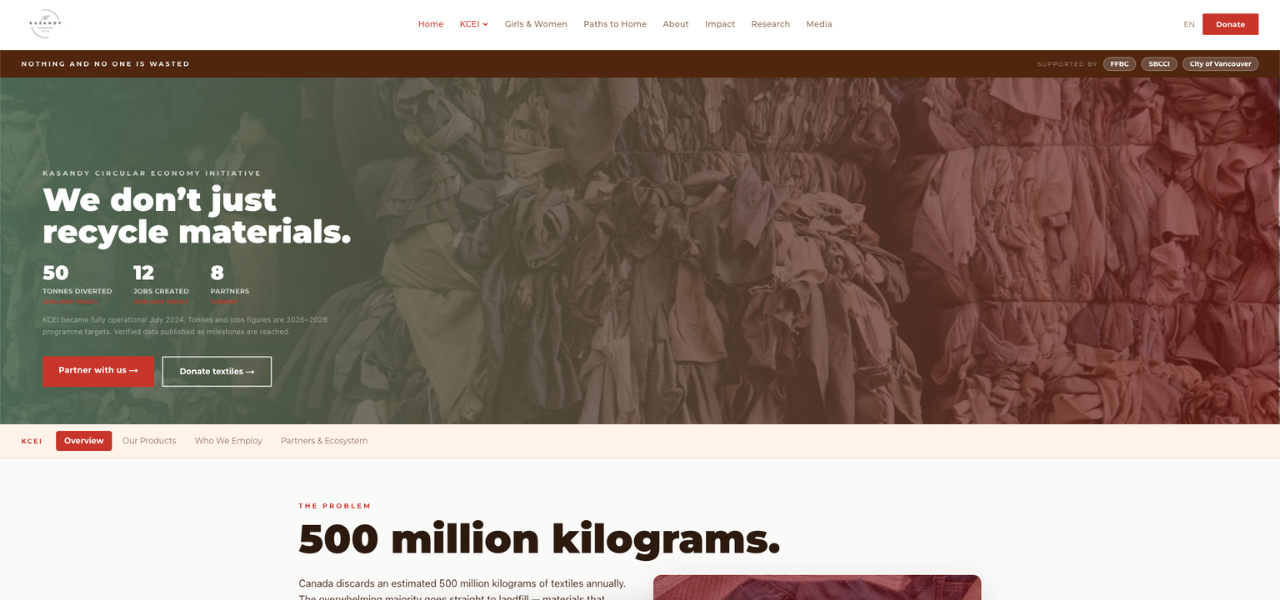
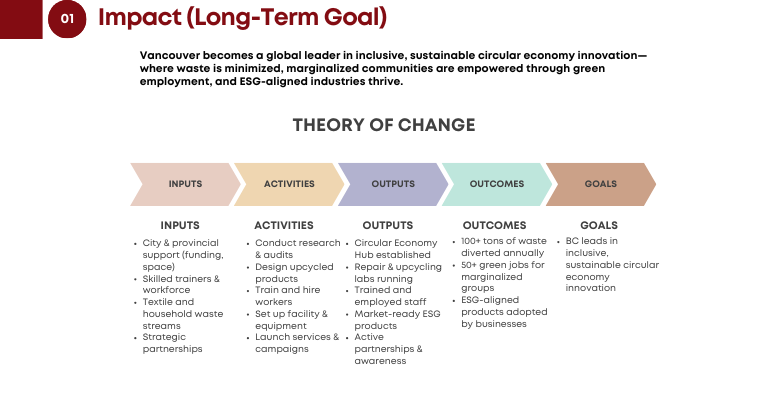
We designed and built the Kasandy Foundation website, structuring a complex, multi-audience program clearly for government funders, municipal procurement officers, corporate ESG partners, and textile donors alike. We then built KCEI's full logical framework — inputs, activities, outputs, outcomes — anchoring the program's 2026–2028 targets of 50 tonnes diverted and 12 inclusive jobs created, and applied that framework directly to grant applications aligned with Vancouver's Zero Waste 2040 plan, BC's Equity Framework for Green Jobs, and federal clean-innovation priorities.
We applied the logical framework directly to grant applications, translating KCEI's mission into the structured, evidence-based language federal funders require. Result: $80,000 in government grant funding secured across multiple applications. We also built the data collection and reporting infrastructure KCEI needs to sustain its funding relationships — intake and tracking systems for textile donations, employment records, and output measurement — and continue to provide ongoing strategic support as the Foundation scales toward its 2026–2028 targets.
The program has been active and fully operational since July 2024, with 8 institutional partners including Emily Carr University and the City of Vancouver. It is endorsed by the City of Vancouver under Zero Waste 2040 and funded by two federal programs: FFBC and SBCCI.
Kronowl continues to support the Foundation with strategic planning — helping the team prioritise next milestones, navigate funder relationships, and position KCEI for scale as the pilot matures toward its 2026–2028 targets. Every target is published transparently as a target, with a public pledge to publish verified data as milestones are reached.